
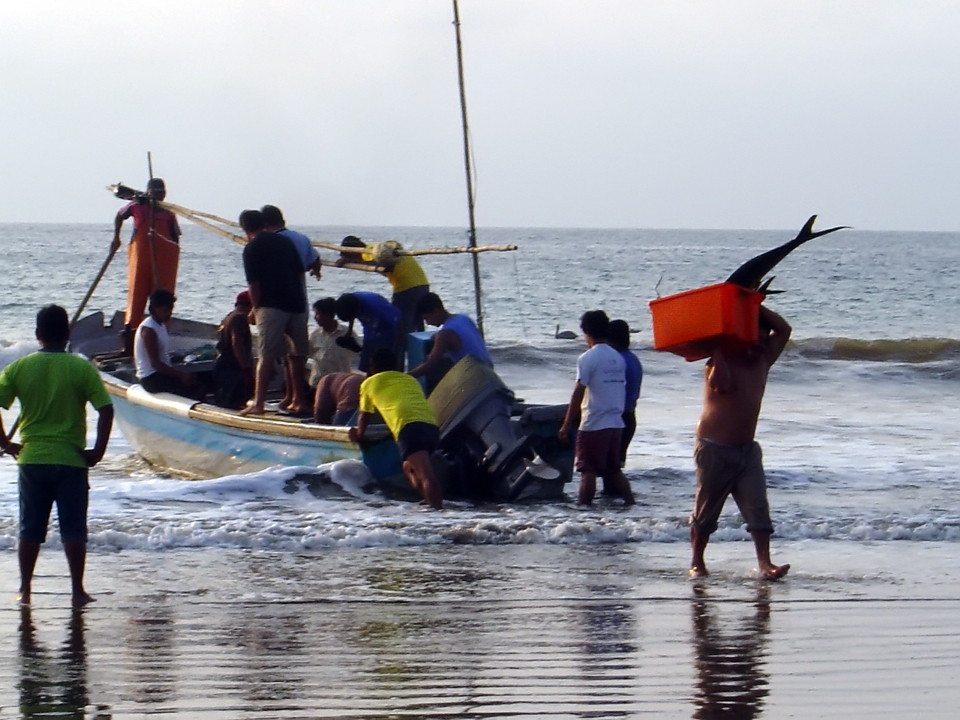
The indigenous people of these lands, representatives of the oldest cultures in the Americas — the Valdivia and the Manteña — were outstanding navigators and fishermen. Their legacy continues to thrive in the 21st century. Archaeological findings in the area of Puerto López and neighboring Salango prove that humans have lived here for more than five thousand years, and that fishing and the gathering of mollusks formed the foundation of their existence. The people of Puerto López, just like their ancestors, live from the sea, its products, and its wealth. Today, tourism, ecotourism, and artisanal fishing constitute the main sources of employment and income for the local population.
The predominant activity is artisanal fishing (pesca artesanal). Every day, all the fishermen of the canton set out in small boats in search of their catch in the vast Pacific Ocean. Wooden boats with oars and sail rafts have almost disappeared. Nowadays, fishermen use modern fiberglass vessels equipped with outboard motors, allowing them to cover great distances in a short time. Most often, the boats leave in the evening to fish during the night and return at dawn to the beach of Puerto López. They use modern fishing gear such as bottom longlines, trammel nets, cast nets, and occasionally harpoons. The most valued species in the catch are corvina, camotillo, and cabezudo. These fish are highly appreciated by both local residents and tourists who come here seeking the authentic taste of fresh seafood cuisine.
The Fisherman Is the Life of the Sea: Traditions and Modernity
Fishermen go out to sea every month of the year. They work with special intensity during the “dark” period — the new moon phase — which corresponds to approximately 22 days each month. Most artisanal fishermen rely on a simple compass as their only navigation instrument. Each boat works in close coordination with the others. There is careful planning based on professional experience and knowledge accumulated over a lifetime at sea. This knowledge is passed down from generation to generation and represents a true living encyclopedia of the ocean.
In recent times, fishermen feel threatened by the monopoly of industrial fishing. The presence of large vessels often leaves the artisanal fishermen without a good catch. As a result, artisanal fishing is weakening, which deeply concerns independent fishermen, especially on clear nights when the fish seek deeper waters. In 1999, the Port Authority of Manta prohibited large ships from entering certain areas. Therefore, local fishermen operate in the maritime space from Puerto López to Isla de la Plata, while industrial vessels may fish further to the west.
Despite the difficulties, artisanal fishing remains the soul of Puerto López. Every morning, the waterfront turns into a real spectacle: boats return with fresh fish, women clean and gut the catch, children help carry the boxes, and the air fills with the scent of the sea. This is a living tradition that tourists can witness with their own eyes. Many travelers deliberately arrive early in the morning to photograph the beginning of the day in an authentic fishing village and capture unique images of their journeys through Ecuador.
Categories of Artisanal Fishermen and the Role of the Community
The artisanal fisherman proper is dedicated to catching fish and crustaceans. There are also oyster gatherers, crab collectors, and those who collect shrimp larvae. The first specialize in marine invertebrates, while the latter gather shrimp fry. In addition, a large number of people are involved in support tasks: fish cleaners and gutters, net menders, loaders, mechanics, carpenters, traders, and many others.
Women play a fundamental role. They actively participate in processing the catch, selling the fish, and preserving traditions. Thanks to their work, artisanal fishing maintains its social and economic importance. Women have also become key participants in sustainable tourism and ecotourism programs, offering visitors homemade cuisine and authentic stories about the life of fishing families.
The Importance of Fishing and the Role of Associations
For the inhabitants of Puerto López, the first golden age of fishing occurred between the 19th and 20th centuries, when the ocean seemed an inexhaustible source of food. Fishing became attractive also due to the influence of customs and religion.
Today there is the Fishermen’s Association Aso Pescar, composed of approximately 80 to 105 members and currently led by Mr. Alipio Paréales. On the northern part of the waterfront lies the fishing terminal, where the catch is unloaded and where canteens, fuel stations, and other essential services operate. This infrastructure was financed by the European Union and the VECEP program.
The association provides fishermen with ice, fuel, social protection, and medical assistance. It also promotes “experiential fishing” (pesca vivencial) — a special form of ecotourism in which tourists can go out to sea with local fishermen and experience their work firsthand. This is one of the best ways to discover the authentic life of coastal Ecuador while supporting the local community.
Gastronomy of Puerto López: The Taste of the Sea and Ancestral Traditions
The foundation of traditional cuisine consists of seafood products: fish, octopus, squid, and shrimp. The most beloved and delicious dishes are:
- Cazuela — a thick stew with all kinds of seafood, prepared in a clay pot;
- Ceviche — fresh fish or shrimp marinated in lemon and bitter orange juice with onion and cilantro, served with chifles (green plantain chips);
- Viche — a creamy and nutritious soup based on seafood, green plantain, cassava, corn, and peanut paste. It is one of the most emblematic dishes of Manabí province and a true must-try for every tourist.
Dishes are also prepared from the large oyster Spondylus, considered a sacred mollusk since pre-Columbian times. These oysters live in colonies at depths between 20 and 120 meters. In pre-Hispanic times, Spondylus was one of the main items of commercial exchange between coastal and Andean peoples. Today it is regarded as a delicacy and a symbol of local gastronomy, as well as an important element of cultural tourism.
Here they prepare excellent stewed fish and the famous Creole chicken (raised exclusively on pure corn). After a good meal, nothing is better than a cup of coffee made from locally grown natural ground beans. Gastronomic tours around Puerto López are becoming increasingly popular among travelers who want to taste the authentic cuisine of Manabí.
Artisanal Fishing and Ecotourism: The Alliance That Saves Traditions
In recent decades, Puerto López has undergone an interesting transformation. While artisanal fishing faces difficulties (overfishing, industrial fishing, and climate change), ecotourism and humpback whale watching (June to October) have become an important complementary source of income for many fishing families.
Many former fishermen have adapted their boats for tourism. Now they take visitors to watch the whales, to Isla de la Plata (known as the “Little Galápagos”), for snorkeling, diving, and sport fishing. In this way, they maintain their connection with the sea while developing sustainable tourism and responsible ecotourism.
Puerto López is not just a tourist town. It is a living museum where every dawn on the waterfront tells the story of five thousand years of culture. Here, artisanal fishing, gastronomy, whale watching, and ecotourism form an inseparable unity. Come to Puerto López to see how ancestral traditions continue to live in the modern world, taste the freshest ceviche, and feel that the sea is not only food, but the soul of an entire people.
Walk along the waterfront at sunrise, talk to the fishermen, try a viche or a cazuela, take a trip to Isla de la Plata or join a humpback whale watching tour, and understand why the bond between people and the ocean is so strong here. Puerto López awaits you — the place where history, the sea, flavor, and nature unite in an unforgettable journey through Ecuador.
Discover Puerto López: one of the best destinations for ecotourism, gastronomic tourism, and marine adventures on Ecuador’s Pacific coast. Here every day begins with the sea and ends with the taste of the freshest seafood.