

The canton owes its name to Daniel López, a philanthropist from Jipijapa. The son of a Colombian father and Guayaquil native Carmen Saltos, López made significant contributions to the development of this region. In his honor, the Municipality of Jipijapa named the beautiful bay after him. However, the history of Puerto López begins long before Daniel López. More than five thousand years ago, the ancient cultures of Valdivia, Machalilla and Manteña already inhabited these shores, mastering navigation, fishing and the trade of the precious Spondylus shell.
Today, Puerto López is far more than a simple fishing village. It is one of the most important destinations for ecotourism on Ecuador’s Pacific coast, the gateway to Machalilla National Park, the best place to watch humpback whales, and a living museum where five thousand years of history meet sustainable tourism and the genuine hospitality of the people of Manabí.
Parishes and Precincts of Canton Puerto Daniel López
The city of Puerto López is the canton’s capital. Its rural parishes are Machalilla and Salango, two of the most emblematic places for tourism and ecotourism in Manabí province. Its precincts include Río Chico, Puerto Rico, Las Tunas, Ayampe, El Pital, Río Blanco, Guale, San Vicente, La Ciénaga, Dos Ríos, Sitio Buena Vista, La Encantada, La Mocora, San Jacinto and El Triunfo.
Each of these places has its own character. Ayampe is famous for its bohemian atmosphere and excellent waves for surfing. Las Tunas and Río Blanco offer experiences of community tourism and hiking. Salango is home to one of the most important archaeological museums on the coast, with artifacts dating back more than 4,500 years. Here visitors can truly connect with Ecuador’s ancestral past.
Geography and Boundaries of the Canton
The canton’s boundaries are as follows: to the north, the Parish of Machalilla; to the south, the area known as Cinco Cerros, which marks the border with Santa Elena Province; to the east, Julcuy and Pedro Pablo Gómez; and to the west, the majestic Pacific Ocean.
Location
The canton lies 165 km from Portoviejo and is located in the southwest of Manabí province, with direct access to the Pacific Ocean. The capital is situated at approximately 1°33′28″ south latitude. It covers an area of 449 km² and has a population of around 15,656 inhabitants.
This privileged location makes Puerto López the ideal starting point for exploring Machalilla National Park, Isla de la Plata (often called the “Little Galápagos”), and the best whale-watching areas for humpback whales on the entire Ecuadorian coast.
Hydrography
Several rivers cross Puerto López: Ayampe, Puerto Rico, Punteros, La Curia, Salango and Riofrío. Most of them are intermittent, except for the Ayampe River, whose flow is permanent. All empty into the Pacific Ocean. More than a dozen river basins form the hydrographic system of Puerto López. The area is also home to a significant number of aquifers that remain largely unused.
These rivers and estuaries nourish the unique ecosystems of Machalilla National Park, where tropical dry forest meets mangroves. This makes the region ideal for ecotourism and birdwatching.
Climate
Due to the influence of the Humboldt Current and El Niño, as well as orographic conditions, the canton enjoys a special climate. From May until October or December, a permanent fine drizzle known as garúa covers most of the territory, varying in intensity according to the cooling of the seawater.
As a result, four distinct zones can be identified: Tropical spiny forest, tropical ultra-dry forest, tropical dry forest and pre-montane tropical forest. The heaviest rains fall between February and April. Average annual precipitation is 424 mm, with evaporation of 879 mm. Relative humidity reaches 84 %, and the average annual temperature is 24 °C.
This mild and sunny climate makes Puerto López an ideal destination for tourism year-round, especially between June and October when the humpback whales arrive to breed in its waters.
Orography
The landscape of Puerto Daniel López is shaped by the Chongón and Colonche Mountain Range, which runs from south to north. Near the coast the terrain is flat and never exceeds 800 meters above sea level. In the mountainous areas the slopes range from moderate to very steep. Notable landmarks include the headlands of El Sombrerito, Bálsamo, El Barquito, Cabezona, Isla Salango and numerous rocky islets.
These geographical features offer spectacular scenery and host ecological trails perfect for ecotourism and adventure tourism, such as the famous path to Los Frailes beach or the routes leading to the communities of Agua Blanca and El Pital.
Economy and Production
Agriculture in the area is mainly oriented toward subsistence. The principal crops are corn and coffee, grown in the communities of Río Blanco, Matapalo, Las Tunas and Río Plátano. Cattle raising also plays an important role and supports approximately 16.9 % of the population.
One of the main economic activities of the inhabitants of Puerto López and Machalilla is artisanal fishing, which provides livelihoods for 47.5 % of the population. However, given the difficulties facing the fishing sector (overfishing, industrial competition and climate change), tourism is rapidly becoming the region’s main economic driver. Projections indicate that the number of tourists could increase by up to 200 % over the next five years.
Ecotourism already supports 22.1 % of the population, while commerce in general employs 19.5 %. In Salango there are small locksmith workshops, tailor shops and bakeries, as well as artisans who produce clay items — a tradition that dates back to pre-Columbian times.
Architecture
In the smaller communities, houses are traditionally built from guadua bamboo with palm-leaf roofs. The same materials have been used in the construction of the canton’s best ecological hotels and hosterías, giving them an authentic and sustainable character. In the capital, buildings are mostly concrete or mixed construction, although traditional reed houses can still be found — living testimony of Manabí’s vernacular architecture.
This traditional architecture has become an additional attraction for cultural tourism and ecotourism, as many eco-lodges successfully combine ancestral design with modern comfort.
Traditional Celebrations
The people of Puerto López are known for being hospitable, joyful and very festive. The majority of the population is Catholic and eagerly awaits the annual festivals in honor of the Virgin of the Immaculate Conception (December 8), Our Lady of Mercy (September 24) and Saints Peter and Paul (June 29).
During these celebrations, processions are held aboard boats at sea, novenas and rosaries are prayed. At Christmas each neighborhood builds its own nativity scene. The Humpback Whale Festival, held between June and September, has become one of the most important events of tourism and ecotourism on the entire Ecuadorian coast.
Dance and Music
Local musical compositions follow the rhythms of boleros, pasacalles and pasillos. There are also copleros and popular musicians who sing about the daily life of fishermen and the sea. Music is an inseparable part of Puerto López’s identity and accompanies both fishing work and tourist celebrations.
Beliefs
The inhabitants of Puerto López believe in witchcraft, supernatural phenomena, visions and spirits. Fishermen tell stories of ghost ships or a mysterious light that travels across the sea above a coffin. A legendary figure is the “witch” or “mother of the mountain,” a woman who wandered through the villages with disheveled hair covering her face. These stories form part of the appeal of cultural tourism and local folklore.
Education
Puerto López’s first public high school was named Eduardo Granja Garcés, and its first primary school was Isidoro Barriga. Today there are three high schools: Colegio Nacional Técnico Fiscal “Provincia de Manabí”, Colegio Particular Paramilitar 5 de Mayo and Colegio a Distancia Camilo Gallego. The canton has 12 primary schools (both public and private) and five preschools.
In higher education, two distance-learning universities operate: the Technical University of Babahoyo – School of Ecotourism and the State University of Guayaquil – Faculty of Philosophy. The presence of the School of Ecotourism clearly shows how important sustainable tourism and ecotourism are for the future vision of the canton.
Coat of Arms and Symbols of the Canton
The cantonal emblem is composed of three horizontal stripes in the colors green, white and blue, with the following meanings:

- Green: represents agriculture and the abundant vegetation found within Machalilla National Park, a site of great tourist interest.
- White: represents the purity of its people and the settlement of the pre-Columbian cultures Manteña, Machalilla and Valdivia.
- Blue: reflects the sky and the riches of the sea, a source of work and livelihood for the local population.
The Coat of Arms of Puerto López rests on a golden-yellow scroll with a torch symbolizing the light of liberty. It is divided into five sections:
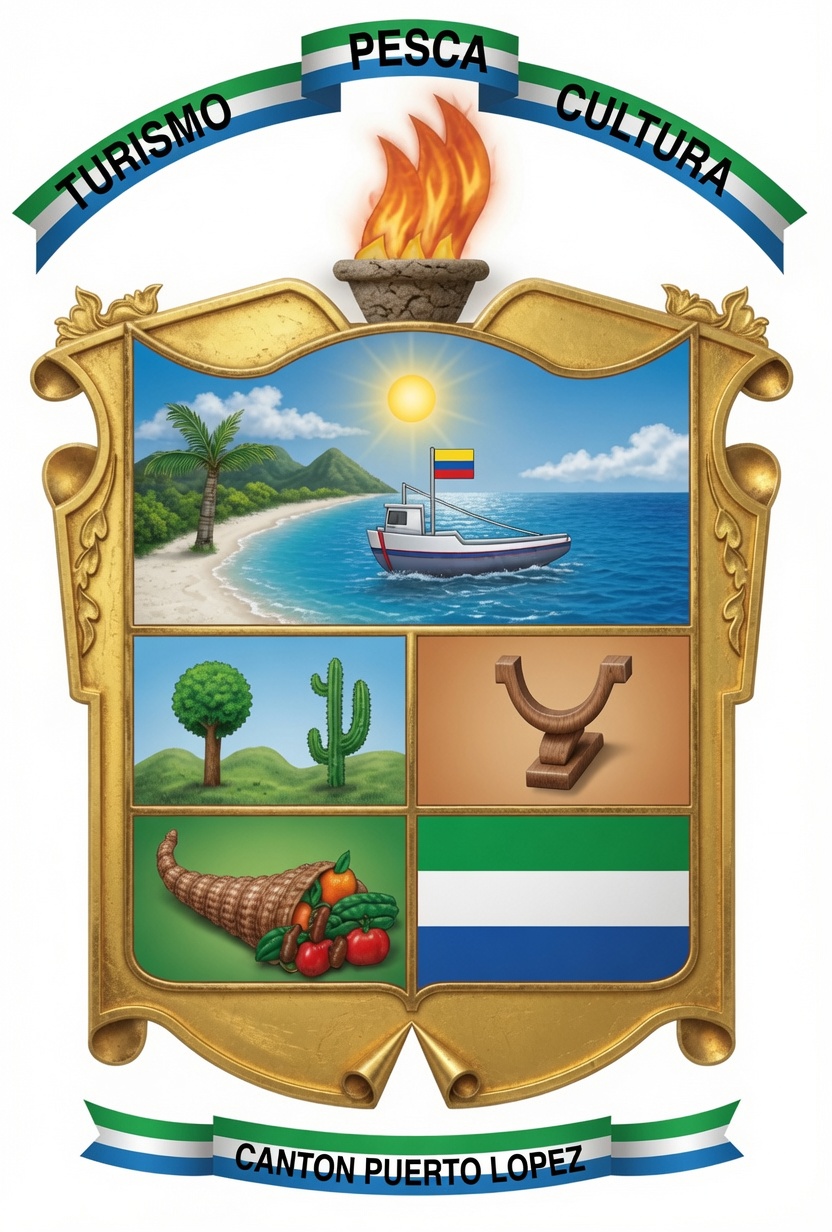 The upper section shows a touristic landscape with beautiful beaches, bays and islets, a fishing boat on the waters of the Pacific Ocean and a flock of seabirds in flight.
- The left section, on a sky-blue background, features a tree and a cactus representing the tropical humid forest and the tropical dry forest — unique on the Ecuadorian coast and protected by Machalilla National Park.
- The right section, on a light-yellow background, depicts the U-shaped stone seat, a symbol of power and an archaeological remnant of the Manteña culture.
- The lower-left section shows the cornucopia of abundance filled with local agricultural products: coffee, tagua, corn, yuca, tomatoes, oranges, tangerines, watermelon and melon.
- The lower-right section displays the cantonal flag.
Above and below the shield appear two ribbons in the colors of the flag with the legends: Tourism, Fishing and Culture.
Puerto López is not just a tourist destination. It is a territory where five thousand years of history, privileged nature and the sincere hospitality of its people come together to offer one of the most authentic and memorable ecotourism experiences in Ecuador. Come discover its beaches, its whales, its culture and its people. Here every sunrise tells a story five millennia long.