
FRANKFURT -- As Condor Airlines celebrates its 70th anniversary in 2026, it is also declaring itself a reborn business.
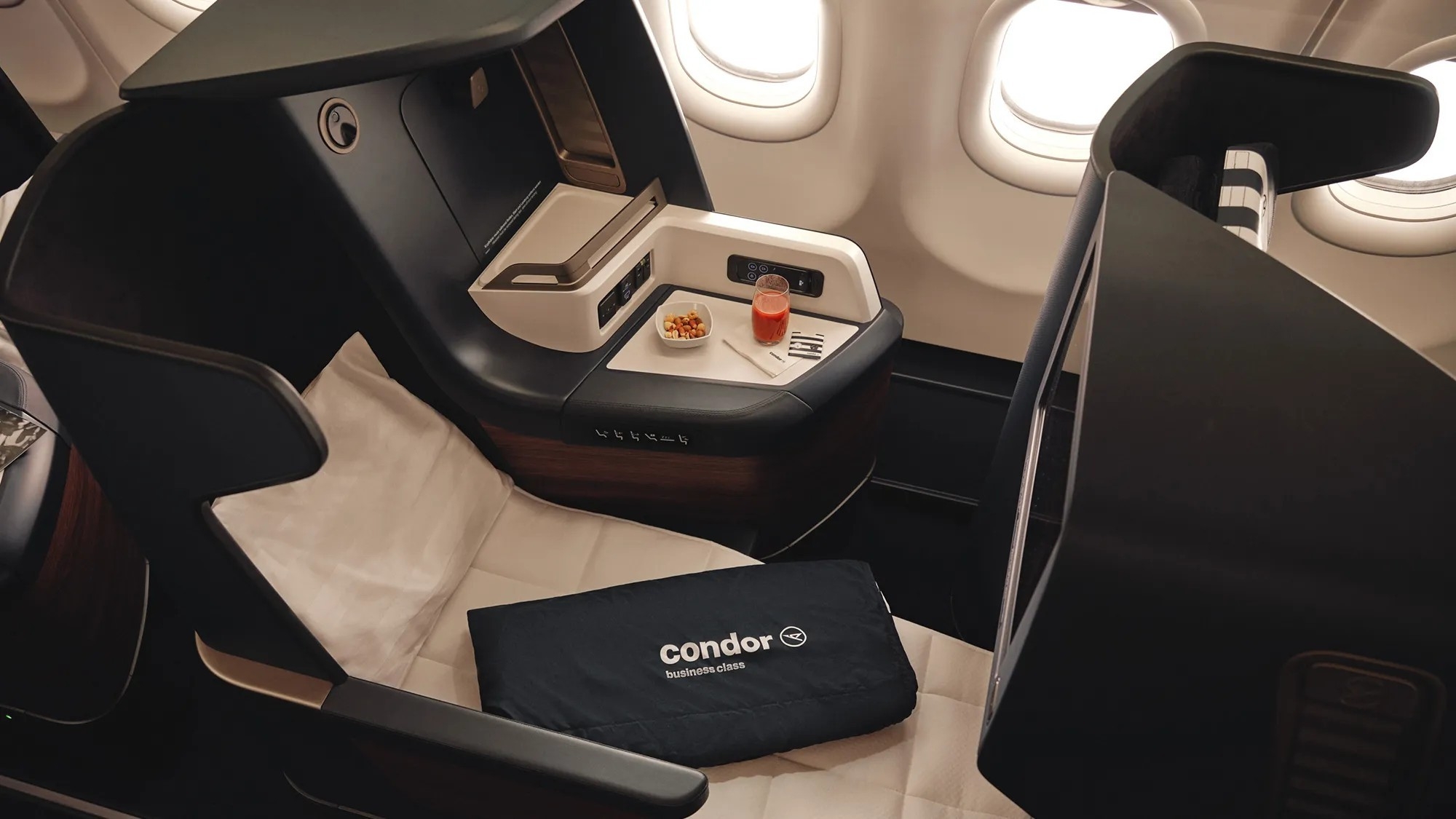 The carrier, based here, has dramatically redefined its product with new aircraft, a denser route system and an approach to business-class service and pricing meant to attract more of its leisure customers to go for the upgrade.
The line said it is now focused on raising awareness among travel agents and a potentially wider customer base. Mikko Turtianinen, director of sales for the Americas, said, "Forget the Condor of the past."
Beginning in 2022, the carrier began taking delivery of what became an all-new fleet of long-haul aircraft. By 2024, all older long-haul planes had been replaced. Total replacement of short- and medium-haul planes will be completed in 2029.
Beginning in 2022, the carrier began taking delivery of what became an all-new fleet of long-haul aircraft. By 2024, all older long-haul planes had been replaced. Total replacement of short- and medium-haul planes will be completed in 2029.
"We did all this starting in the pandemic, investing in the planes while others were saving," Turtianinen said. The line, which has had an interline and frequent flyer partnership with Alaska, last August launched a similar partnership with JetBlue. More recently, it reached an interline agreement with Southwest in December.
U.S. cities currently served through the Alaska and JetBlue partnerships are Anchorage, Boston, Las Vegas, Los Angeles, Miami, New York, Portland, Ore., San Francisco and Seattle.
The Southwest partnership launched with Seattle service earlier this month and will expand to Boston, Las Vegas, Los Angeles, Portland and San Francisco when Condor resumes flying to those cities from Frankfurt in the spring. All U.S. service is nonstop into and out of Frankfurt, scheduled with connections to Condors rapidly growing ex-Frankfurt services in mind.
The carrier, once known for its service to midlevel destinations and best known as a leisure line, has set the stage to effectively challenge its biggest competitors, Turtianinen said. "Now we have a fantastic product" for all travelers, whether corporate or leisure, individual or group, he said.
In December, I traveled one way, Frankfurt to New Yorks JFK, in business class an A330neo as part of a press trip. It gave me a chance to sample meal services, entertainment systems and, most importantly for me, the lie-flat beds.
Condor has no first-class cabin, but, on the A330neos, it has set aside the first four seats in business as Prime Seats, with added space -- two passengers could dine together; larger screens; and more amenities.
Turtianinen emphasized that all Condor widebodies have the same configurations. In business class, seating is 1-2-1 across, because, he said, "after spending several thousand dollars for a ticket, no business-class passenger should have to climb over anyone for access to the aisle."
The seats recline to beds measuring 76 inches by 19 inches, and there are 17.3-inch screens with touchscreen and remote control at each seat.
According to Turtianinen, Condors business-class rate is generally 30% lower than that of competitors and can be as much as 50% lower. Its "affordable luxury," he said, the sort that leisure travelers might pay "when making a special trip."
He said the line has now turned to cultivating its B2B relationships to raise awareness at all levels -- awareness of the reinvented Condor, its expanding network and its price appeal.
On the widebodies, Condor offers economy and premium economy, each configured as 2-4-2 across, but with considerably more personal space in the premium version.
Coinciding with Condors remake is JFK Airports $19 billion overhaul. As a result, Condor and numerous other airlines will relocate out of Terminal 7, which is being knocked down, and into the all-new Terminal 6 at the New York airport. Condor expects to relocate in April.